Historian / Writer / Speaker
Professor of History, Calvin University
Senior Democracy Fellow, Public Religion Research Institute
Live Laugh Love: Book Club Discussion Guide

Over the years, I’ve gotten thousands of letters from readers of Jesus and John Wayne. Nearly all of them say some version of the same thing: “This is the story of my life, but I never understood how all the pieces fit together.”
Live Laugh Love does the same thing, but there are many more pieces, and the picture they make will reshape how you see…everything. At least it did for me.
So, buckle up…
Download LLL Book Club Guide
**Note: May contain some spoilers.**
Part 1: The Spirit and the Flesh
This book may not start off where you expect. It didn’t end up starting where I expected it to! Part 1 is a bit of a wild ride and it goes down a few rabbit holes. One of the reasons the book took so long to write is because I kept adding chapters on the front end, but I knew I needed to go back in time to decipher what was in front of me.
The book is also more complex than Jesus and John Wayne. It’s not just about evangelicals; it’s also about Mormon and mainline and charismatic women, about the secular philosophy of positive thinking, and about how all these strands intertwine.
A word of advice, as you embark on Part 1. You’re going to come across a lot of names, many of which may be unfamiliar to you. Don’t stress it. There’s no exam at the end, and I’ll remind you who’s who as we pick up various threads and begin to see how the little pieces create a bigger picture.
Chapter 1: The Secret
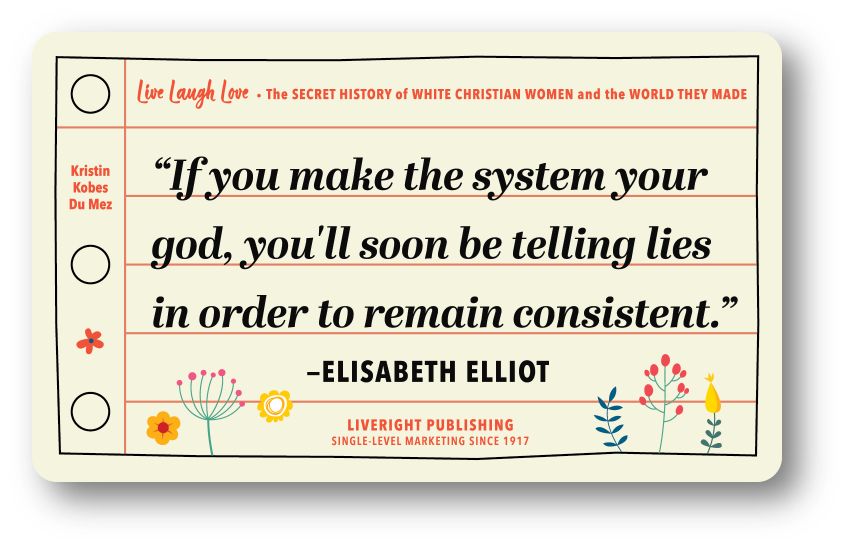
The first chapter will remind you that I am in fact a historian. I’d originally planned to start the book in the 1960s and 1970s, but then I noticed how the women I was looking at—Catherine Marshall (author of Christy), Elisabeth Elliot (of missionary and purity culture fame), and Marabel Morgan (of Total Woman fame), and even Mary Crowley, one of the pioneering evangelical multilevel marketers, all looked to one woman for inspiration: the 19th-century holiness preacher Hannah Whitall Smith.
But why? That’s the question I start to tease out in Chapter 1.
Plenty has been said about evangelicalism, good and bad. What I’m doing here is getting a bit more granular. Understanding holiness theology helps us understand the shape evangelicalism takes over the course of the twentieth century.
Chapter 1also sets up themes that will resurface throughout the book: Life is messy. Genuine faith is never static. What happens when Christians who are taught to surrender their wills and promised perfection—holiness and happiness—but those things fail to materialize? What happens when bad things happen, even to good people? How does faith adapt?
Have you encountered Hannah Whitall Smith before, and if so, where? Did any part of this chapter resonate with your own experiences?
Chapter 2: Believe and Want
At some point in Chapter 2, you’re going to be wondering: Why am I reading this? Remember, Live Laugh Love isn’t just about evangelicals. The book weaves together three overlapping strands, and one of those is New Thought—which evolves into the philosophy of positive thinking.
Where have you encountered the teachings of New Thought, or New Thought’s feminine ideal?
Chapter 3: God-Control
In this chapter, we see start to see some of the ways that those with power tried to control the unpredictable and disruptive power of the Spirit, in all its guises. We also meet someone you probably haven’t heard of before: Frank Buchman. In Buchman, we can see how holiness teachings can themselves become mechanisms of control. We can also see how the allure of power becomes institutionalized. If you feel a bit of a sense of foreboding as you read this chapter, you’re reading correctly.
What parts of this chapter jumped out at you as likely to be important?
Chapter 4: Different Sides of the Same Street

At this point, you’re probably going to start wondering: Wait, isn’t this supposed to be a book about women? Why all these men? I know, I had the same thought when I was writing this chapter, but they need to be there to tell the bigger story. By centering women overall, I realized that the old mapping of twentieth century American religion wasn’t holding together. We like to separate evangelical from Pentecostal from mainline from secular culture, but to tell the stories of the women in this book, I needed to rethink those categories.
Norman Vincent Peale, Billy Graham, Oral Roberts—the Protestant mainline, evangelicalism, and Pentecostalism—were working “different sides of the same street.” They were fashioning a blend of positive thinking, evangelicalism, and prosperity theology, a faith that was perfectly suited to consumer capitalism and one that bolstered the power of corporate America. This is a critical backdrop to understanding the world the women in Part 2 inhabit—with all its opportunities and constraints.
The end of Chapter 4 may seem weird to you. Or it may be the missing piece that suddenly starts to click all sorts of things into place.
What most surprised you in this chapter?
Part 2: The World We Wished For
Congratulations, you’ve made it through the historical weeds and rabbit trails! Now we start the fun part and begin to meet women who may be familiar to you: Catherine Marshall, Elisabeth Elliot, Helen Andelin, Marabel Morgan, Anita Bryant, Amy Grant, and so many others. But what these women say and do makes so much more sense now that you have a sense for this earlier history.
Chapter 5: Cinderella’s Rags
This is where I’d originally hoped to begin the book: with Catherine Marshall and Elisabeth Elliot.
If you were familiar with Marshall and Elliot before reading Live Laugh Love, what did you learn that was new here, and why do you think that matters?
Chapter 6: It Is You Who Have Failed
This chapter is a fun one. If you think about mommy blogs or trad wives or MLMs or influencers, you know that Mormon women are part of this story. With Helen Andelin, we can see how and why.
Why do you think Fascinating Womanhood appealed to so many women? What did they see in it? Was it empowering?
Chapter 7: Love and Obey
When I wrote Jesus and John Wayne, I included a section on Marabel Morgan. At the time, I knew that Morgan had a Mormon predecessor, but I didn’t have the space to fully explore that connection. When I finally turned back to that history, it ended up unlocking one of the central threads of the book: the relationship between New Thought/positive thinking, Mormonism, and American evangelicalism.
Chapter 7 also does some heavy lifting, showing how fundamentalism and Pentecostalism and mainstream evangelicalism blend together, and how Calvinism and Spirit-filled Christianity and positive thinking come together. Many histories examine one of these strands in isolation, but to understand modern American religion, we need to understand how all these strands come together. This is the backdrop to popular Christian women’s culture, to modern American religion generally, and to contemporary Christian nationalism.
Which parts of this chapter were most familiar to you?
Chapter 8: Selling America
Finally, we get to talk about MLMs! This chapter involved an immense amount of research as I began to tease out not only the history of multilevel marketing, but also the relationship between multilevel marketing, post-WWII evangelicalism, and the Christian Right. Years before Jerry Falwell started the Moral Majority, men like Bill Bright, Rich DeVos, Paul Weyrich were scheming about how to take back the country for God—and for free-market capitalism.
For those who have participated in MLMs, what rang true to your experience? What parts of this chapter surprised you?

Touring Amway
Chapter 9: Root, Hog, or Die
This was my favorite chapter to write. Growing up, I loved Love Comes Softly, and I tried to bring the book to life for readers of Live Laugh Love. My analysis of Little House on the Prairie and libertarian economics draws on existing scholarship, but when it came to Love Comes Softly, I’m breaking new ground.
Histories of the Christian Right tend to focus on “family values issues,” but equally as important are economic values: anti-New Deal liberalism, anti-regulationism, and pro-corporate power and free-market capitalism.
Chapters 8 and 9 both show how for many, free-market capitalism became synonymous with “the American way,” and with American Christianity. What parts of Christian teaching needed to be suppressed or revised for this narrative to take hold?
Chapter 10: Like a Virgin
People often ask me if I grew up inside evangelicalism. It’s a tough question because it depends on how one defines evangelicalism. I certainly didn’t identify as an evangelical, and Billy Graham and Elisabeth Elliot were not household names in my home. I grew up in a small Dutch Reformed denomination, in a small town in Iowa. But…I did listen to Amy Grant and Sandi Patty! As I explained in Jesus and John Wayne, I think it’s more useful to think in terms of how immersed a person might be in evangelical culture rather than trying to put someone inside or outside an “evangelical” box.
Amy Grant was one of my favorite people to write about, and this chapter really came together when I realized that her album Unguarded came out around the same time as Elisabeth Elliot’s Passion and Purity.
Do you have experience with “purity culture”? Are there things in this chapter—and in earlier chapters—that give you a new perspective on where purity culture came from and what it was doing?
Chapter 11: Holy Crap
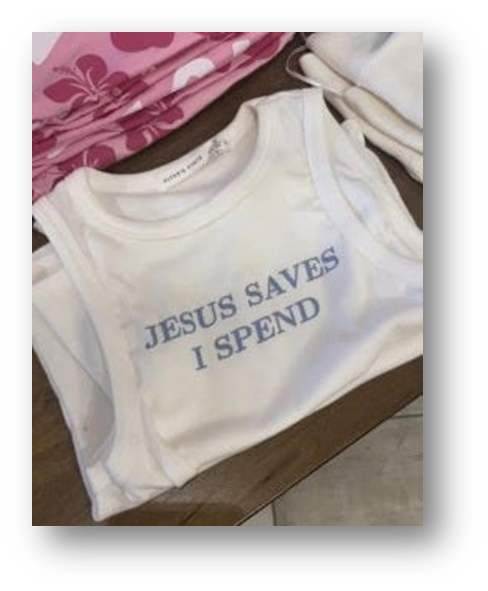
This was the hardest chapter to write. Everything in this chapter needs to be in a book called Live Laugh Love, but each one could be its own book—and there were many more things I could have added! Not only does the chapter bring us into the modern era of Christian retail, but like Chapter 10, it also points to how Christian products begin to shape a wider secular culture.
The end of the chapter mentions Calvin Seerveld’s critique of Christian kitsch and Precious Moments figurines. I knew about that critique because I heard it myself as a student at Dordt College, where Seerveld came to speak. I remember it vividly because I loved Precious Moments figurines and part of me resisted his critique while another part of me thought he was on to something. I carried that tension with me, for decades.
When writing this book, I tried to find an article where he discussed this, but I couldn’t find it anywhere. I talked to his friends, searched databases, and kept coming up empty. Then, one day while sorting bins in my basement, I came across a folder containing a yellowed Dordt newspaper covering that lecture. Inside that folded paper was a sheet of notebook paper, filled with my own meticulous notes from the lecture.
The lecture had struck me as so important at the time that college-age Kristin saved it for future Kristin. Future Kristin found it at just the right time. For the record, I still like Precious Moments. And I still think Seerveld was on to something.
Which parts of this chapter make you want to push back? Which products do you still love?
Available at Altar’d State
Part 3: Casting Stones
From this point on, the book enters the territory of recent memory for many of us. It also engages politics more directly, as we begin to assess the political manifestations of the wide-ranging culture we’ve pieced together in Parts 1 & 2.
Chapter 12: Kill The Darlings
Here we see the disruptive power of the female blogosphere, and the eventual efforts of religious gatekeepers to crack down on that power. It’s worth noting that words like “power” and “gatekeeping” often carry negative connotations, but note that earlier in the book, theological gatekeepers also used their power to crack down on harmful teachings like faith healing that led to tragic deaths. Whether you think the gatekeeping in this chapter is good or bad will depend on your own values, and I don’t expect all readers to reach the same conclusions.
How do you approach questions of theological gatekeeping and boundary-drawing? When do these practices cross over into harm, or coercive control?
Chapter 13: Lipstick on Pit Bulls
What do Sarah Palin, Michele Bachmann, Megyn Kelly, Beth Moore, Paula White, Katie Britt, Lara Trump, Tia Levings, and Erika Kirk all have in common?
They are all living in a world shaped by ideals of Fascinating Womanhood.
We all are.
How do the previous chapters explain the phenomenon of Republican femininity and the distinctive style modeled by women in Trump’s orbit?
Conclusion: Live Laugh Lie
When I’d finished writing JJW and we were in the final stages of editing, my editor sent me an email. “This book is really depressing,” he said. I agreed. “No, this is a problem,” he responded. I couldn’t do that to readers. I needed to give them hope. After thinking long and hard about what to do, I reworked the last paragraph and ended with: What was once done might also be undone.
It felt feeble at the time, but there is truth in that.
This time around, I wanted to offer readers a little bit more. Throughout the book, I drop in voices that show another way. Reinhold Niebuhr, Rachel Held Evans, Sarah Bessey, and Nadia Bolz-Weber all bring theological challenges to theologies of purity, prosperity, and power, and in the conclusion, I bring in Wynand de Kock.
Where do you find hope or empowerment in this story? What do you want to carry with you from what you’ve read here?
(c) 2026 Kristin Kobes Du Mez

Kristin Kobes Du Mez / by Jen VanderHeide